








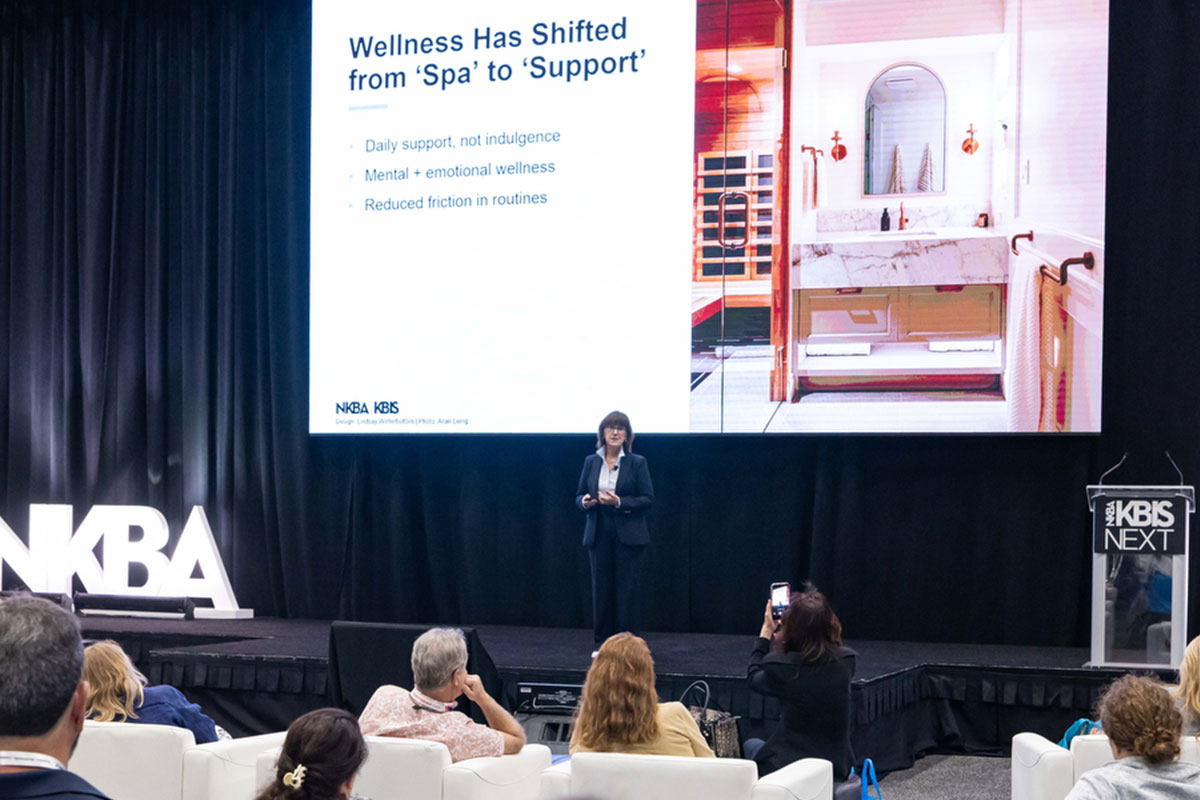
In a compelling presentation on the KBIS Next Stage in Orlando, NKBA’s Director of Research, Tricia Zach, discussed how lifestyle shifts are impacting design for 2026 and beyond.
By NKBA Staff
The story of the 2026 home is about experience. People want spaces that support well-being, reflect who they are, simplify daily routines, and adapt as their needs change.
Increasingly, they want the whole home to feel cohesive — connected visually, functionally, and emotionally. Kitchens and baths are often where that whole-home story begins.
This was the overarching message from Tricia Zach, Director of Research for NKBA, who presented “2026 Kitchen & Bath Trends: The Themes Shaping the Future of the Home,” at KBIS 2026 on the Next Stage in Orlando. She shared insights gleaned from two NKBA research reports — 2026 Kitchen Design Trends and 2026 Bath Design Trends — as well as designer input, project data and emerging consumer patterns. She shared the theme-based analysis through a slightly different lens.
“Rather than treating kitchens and baths as isolated rooms, we’re looking at how they connect to broader patterns shaping the entire home,” Zach said. “Kitchens and baths aren’t just functional anymore — they’re lifestyle hubs, wellness spaces, and the backdrop to everyday life. And the trends we’ll be discussing reflect deeper shifts in how people want to live, feel, and function at home, across generations and life stages.”
Shifting consumer behavior has resulted in a cross-convergence of trends, and designers are shaping decisions beyond K&B, across connected spaces and the broader home, with the same priorities appearing in multiple living spaces. These trends reflect meaningful shifts in consumer expectations — and they’re influencing whole-home design decisions.
“One of the biggest shifts we’re seeing isn’t just what clients want, it’s how they approach design decisions,” she said. “Today’s client is more informed, more intentional, and far less interested in chasing trends just for the sake of it. They’re asking better questions, and they expect design decisions to support how they actually live. So, this isn’t just a trends conversation, it’s a snapshot of how the home is evolving. Designers are no longer just specifying finishes, they are interpreting lifestyles, translating daily routines, wellness needs, and future flexibility into physical space, and to help guide long-term decisions.”
Zach organized the findings into six major themes (instead of room-by-room) to illustrate the bigger patterns shaping the home. “These themes aren’t mutually exclusive,” she added. “Many share overlapping attributes and values, so you’ll hear common threads across multiple themes. Those threads weave together a cohesive design story across the entire home.”
1. Personalization as the New Standard
Homeowners increasingly want spaces that reflect who they are and support their daily routines, preferences and personal rituals. What was once considered a premium or custom upgrade has now become an expectation across all price points. This is being driven by lifestyle diversity: multigenerational homes, hybrid work, blended households. The idea of a one-size-fits-all ‘standard kitchen’ or ‘standard bath’ just doesn’t exist anymore.
In the kitchen, personalization shows up in both form and function. Look for:
- Spaces dedicated to personal rituals (grooming, makeup, wellness routines).
- Mixed cabinet finishes that create a curated look
- Islands designed around entertaining, prep, or seating
- Decorative lighting that expresses personality
- Appliance settings tailored to individual users.
In the bath, which is the most personally tailored room, personalization becomes even more individualized.
- Shower presets for temperature and spray preferences
- Storage designed around daily-use items
- Lighting that shifts with mood and time of day
- Spaces dedicated to personal rituals (grooming, makeup, wellness routines).
2. The Wellness-Driven Home
Wellness has also shifted from a luxury to a universal expectation, and it’s shaping design decisions from the start. Homeowners want environments that support mental, physical, and emotional well-being, and they prioritize light, water and air quality, and calm.
Designers prioritize stress reduction, cleaner air, natural light and a sense of calm and balance. Younger homeowners often focus on restorative environments and emotional well-being, while older homeowners prioritize comfort, accessibility and physical ease.
Invisible wellness by design: Some of the most impactful wellness decisions are the least visible. Lighting quality, acoustics, airflow, water quality and filtration, layout and materials all shape how a space feels to live in — often more than the finishes themselves.
In the kitchen, wellness shows up through both environmental and functional choices:
- Larger windows and increased access to natural light
- Stronger indoor–outdoor connections
- Improved ventilation and cleaner indoor air
- Improved ventilation and cleaner indoor air
- Appliances that support healthier cooking
- Hidden or integrated storage that reduces visual clutter.
In the bath, wellness is often the primary driver behind every design decision:
- Spa-style showers featuring steam, aromatherapy, and lighting therapies
- Integrated or built-in seating to support comfort and accessibility
- Natural light treated as a design priority
- Spaces intentionally designed for relaxation, decompression, and mental reset.
Spa-like features resonate across generations, but they’re often paired differently.
Younger homeowners may be drawn to the experience and ambiance, while older homeowners tend to prioritize comfort, support, and features that reduce physical strain.
Together, these elements position the bath as the most restorative space in the home.
3. Space Expansion & Smarter Functionality
Homeowners increasingly want homes that work harder for them, with rooms expanding in both footprint and purpose. This results in a fundamental rethinking of space. We see more multifunctional, flexible rooms; more visual openness, and more streamlined, simplified layouts that are responsive to everyday life and redefine how people live in and move through their homes.
In the kitchen, smarter planning can make the space feel larger and calmer without increasing square footage:
- Adjoining pantries that shift storage and prep out of the main kitchen
- Adjoining pantries that shift storage and prep out of the main kitchen
- More open, flexible layouts that support multiple activities
- Reduced visual clutter through better organization
- Clear separation between primary and secondary functions.
In the bath, space expansion and smarter functionality are closely intertwined, and function is built in rather than added on:
- Paneled appliances
- Larger showers replace tubs
- Layouts designed around wellness and accessibility
- Storage is intentional and item-specific
- Built-in niches, seating, electrical outlets, and charging to reduce clutter.
4. Seamless, Organic, Earthy Design
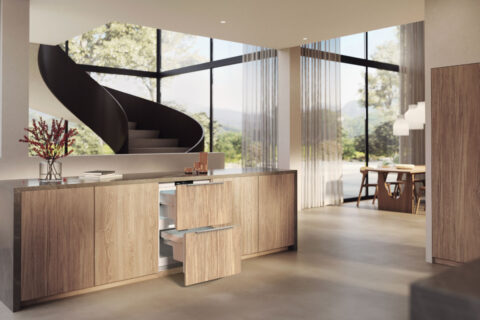
“Seamless, organic, earthy design is the aesthetic expression of many of the values we’ve already discussed — calm, balance, and connection to nature,” Zach said. “We’re seeing a clear shift in the aesthetic mood of the home. Warm neutrals, soft greens, and natural wood tones are creating spaces that feel calmer, more grounded, and more connected to nature — reinforcing the growing emphasis on wellness and emotional comfort. These choices maintain visual calm and reinforce flow between kitchen, living spaces, and the outdoors.”
In the kitchen, this is expressed through material continuity and visual restraint:
- Light woods and natural textures
- Countertops that extend into backsplashes
- Paneled appliances
- Paneled appliances
In the bath, the focus is on continuity and softness to create a bath that feels calm, restorative, and easy to live with:
- Earthy, nature-inspired palettes
- Large-format tiles
- Organic materials and textures
- Biophilic elements.
5. Purpose-Driven Technology
This is one of the clearest mindset shifts revealed in the research. Homeowners don’t want more technology, they want better technology that simplifies everyday routines. There’s growing resistance to anything that feels intrusive or complicated. Smart features are valued when they enhance comfort or convenience. Smart features are designed to blend in — not stand out — and should support function and lifestyle without disrupting the overall aesthetic.
In the kitchen, practical technology leads the way, designed to support convenience, efficiency, and everyday routines:
- Growing interest in smart toilets and bidets.
- Wi-Fi-enabled appliances streamline tasks
- Smart refrigeration supports organization and healthier habits
- Motion-sensor lighting improves ease of use
- Embedded charging keeps technology discreet.
In the bath, technology helps create spaces that feel restorative, comfortable, and intuitive. The goal is simple: support the bath’s role as a personal sanctuary—without taking center stage.
- Intuitive, shared layouts.
- Thermostatic valves and programmable showers
- Heated floors and towel warmers
- Growing interest in smart toilets and bidets.
6. Designing for All Ages and Abilities
Universal design is being reframed, not as a medical necessity, but as a marker of thoughtful design, long-term value, and spaces that support people comfortably through every stage of life.
In kitchens, universal design often isn’t obvious, it simply feels comfortable and intuitive. Features that reduce strain and support independence — especially in multigenerational households — include:
- Clear pathways
- Ergonomic storage that’s easy to reach
- Multi-height work surfaces
- Adjustable, layered lighting
- Intuitive, shared layouts.
In the bath, universal design is more visible — but it’s still about comfort, ease, safety, and thoughtful integration, rather than medical necessity. When designed well, these features blend seamlessly into the space, creating baths that feel elevated, spa-like, and supportive across life stages.
- Barrier-free showers
- Integrated seating
- And wider clearances for easier movement through the space.
What This Means for Designers
“We’re designing for longevity, flexibility, and emotional return on investment — not just visual impact,” Zach observed. “The most successful designs are the ones that adapt gracefully over time. Features such as open layouts, integrated seating, and seamless transitions improve safety and accessibility without calling attention to themselves.
The idea of accessibility has evolved. It’s now recognized as good design, thoughtfully and beautifully integrated.
Designers should be designing for longevity, offering flexibility over fixed solutions, and knowing that emotional ROI matters. The most successful designs are the ones that adapt gracefully over time.”
Pulling It All Together
The same themes — personalization, wellness, smarter functionality, seamless design, purposeful technology and universal design — are shaping the entire home. Together, these trends indicate a 2026 home that is thoughtful, human-centered and made for real life.
The story of the 2026 home is really a story about experience. Kitchen and bath trends shape the entire home. People want spaces that support well-being, reflect who they are, simplify daily routines, and adapt as their needs change. And increasingly, they want the whole home to feel cohesive — connected visually, functionally, and emotionally.
“Designing for 2030 starts in 2026,” Zach concluded. “These are foundations, not fads. What we are seeing in kitchens and baths today is shaping how the entire home will evolve over the next several years. And designers are at the center of that shift.”