





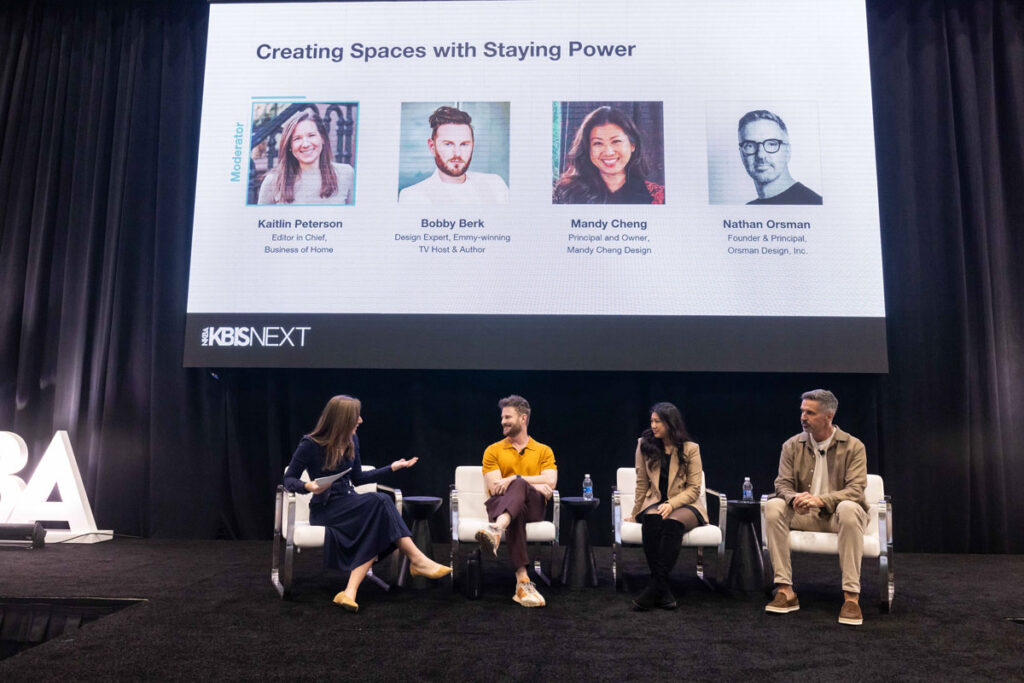
The three designers participated in a panel discussion on the KBIS NEXT Stage in Orlando.
By NKBA Staff
At a NEXT Stage panel on Tuesday at KBIS, NKBA introduced its 2026 Design Council and featured the trio on a lively panel moderated by Kaitlin Peterson, editor in chief of Business of Home. The new Design Council includes design expert, TV host and author Bobby Berk; Mandy Cheng, principal and owner of Mandy Cheng Design, and Nathan Orsman, founder and principal of Orsman Design Inc.
The panel offered strategies for creating designs with staying power, ways to translate the avalanche of ideas gathered at KBIS into real-life projects, and how to manage client expectations.
Peterson began by asking what staying power in design means.
“The first thing I think about is function,” said Berk. “If the space is not functional, the designer will be frustrated, the client will be frustrated, and that design won’t last. Clients don’t usually talk about function first, they’re more interested in aesthetics, but it’s our job to think about function.”
Cheng concurred. “Functionality is huge. Often, they come in with a photo of a design they love, but their space isn’t the same shape or dimensions, so that design won’t fit. We take elements of that aesthetic and make it practical for their lifestyle.”
Orsman, said staying power has to do with soft lighting. “We see a lot of harsh, linear lighting in design today,” he observed. “It’s important to have well-lit spaces, but the lighting needs to be soft. If it’s too harsh, the design won’t last. Harsh light is blinding, your pupils constrict and you actually see less.”
Peterson asked about whether clients should chase trends, and what dates a kitchen. Berk said backsplashes, colors and tile often look dated quickly, while Orsman noted that clients should “think about beauty.”
“Trends are fun for a moment but often don’t last. A beautiful element will last. The beauty of what we do is we can experiment with other people’s money,” Orsman laughed. “If the client loves and wants certain trends, we can learn and adapt some of those ideas to other projects.”
The “Budget” Conversation
All three designers said the budget obviously impacts the entire approach to design, but they suggested strategies for where to save and where to spend for the best value.
Cheng said she starts the conversation not only by asking about the budget, but by asking where the client expects to be in 10 or 20 years, and how they expect their lifestyle to change. For instance, whether children will be grown and out of the house, or whether this is a “forever home.” She also encourages her clients to do what makes them happy, because ultimately, it is their space and they will live in it.
The designers agreed that the dollar investment will vary based on how long the homeowners expect to live in that home, but Berk said he encourages his clients to love their space and not worry too much about resale value. “I tell my clients, ‘You’re living in this house now — enjoy it!’” he said. “Go trendy with things that are easily replaceable, like paint or wallpaper, tile or color.”
But acknowledging that the specter of resale often figures into remodeling decisions, the trio agreed that the public rooms — especially the kitchen — and the primary bath generally yield the best return on investment, so that’s where to focus the budget. Berk noted that prioritizing where to spend helps to value-engineer without sacrificing the integrity of the design.
Cheng advises her clients not to skimp on kitchen choices because it calls into question the quality of the rest of the house. “When prospective buyers come through and see subpar cabinetry or after-market appliances, it makes them think about what else might be shoddy or low-quality throughout the house. It’s worth investing in high-quality, name-brand appliances.”
She also said that if homeowners don’t have the right budget to do the things they want, they need to be educated about what’s possible, and expectations need to be managed so they understand the design options that are possible within their budget.
Navigating the Trends
Peterson asked the panel how to distill all the product, trends and information gathered at KBIS to make sense for their clients.
“You come to a show like this and create a toolbox, and then bring a selection to the client,” Cheng said.
Orsman added that his team doesn’t recommend any product that they haven’t seen in person. “At a show like KBIS, you can see, touch and evaluate the quality of the product, how it feels. Like the weight of a high-quality wooden door.”
Talking about technology in homes, Berk said he’s using a lot of wellness technology, particularly in the bathroom, with features like med-spas. “Invest in a good toilet,” he said. “Clients think they don’t want to spend on a high-end toilet, but once they have it, they’re glad they did.”
Orsman said there’s a trend toward a simpler user experience. We still integrate a lot of smart-home technology in homes, but we’re making it simpler for the homeowner to use. “Sometimes, you have to hold the client’s hand.”
Connecting With Emotions
Design is emotional, and learning what stirs certain emotions is critical to a successful project.
Orsman said he finds a big connection with artwork and family photos. “A space can be beautiful, but it doesn’t come together until there’s artwork in place.”
“We ask all kinds of questions,” said Berk. “What’s their dream vacation, favorite movies or TV shows, anything to learn about their design psyche. We ask about the things they love.”
Cheng added that she asks her clients throughout the process about what moves them. “It comes in layers,” she said. “Clients can’t tell you everything in that first meeting. You keep asking, then you take the arsenal of their ideas and analyze them to decipher what they mean and develop the plan. That’s big for the client — when you make it come together and they see you understand what they want.”