








Global Connect Advisor Laetitia Laurent explores design signals from Europe and how they’re shaping trends in North America.
By NKBA Staff
“There are lots of trends in Europe that make it to the American market a year or two after emerging there,” said Laetitia Laurent, principal of Laure Nell Interiors, with studios in Paris and Boca Raton, Fla. “It’s important for brands to understand and identify these trends so they’re ready when they come to the U.S.”
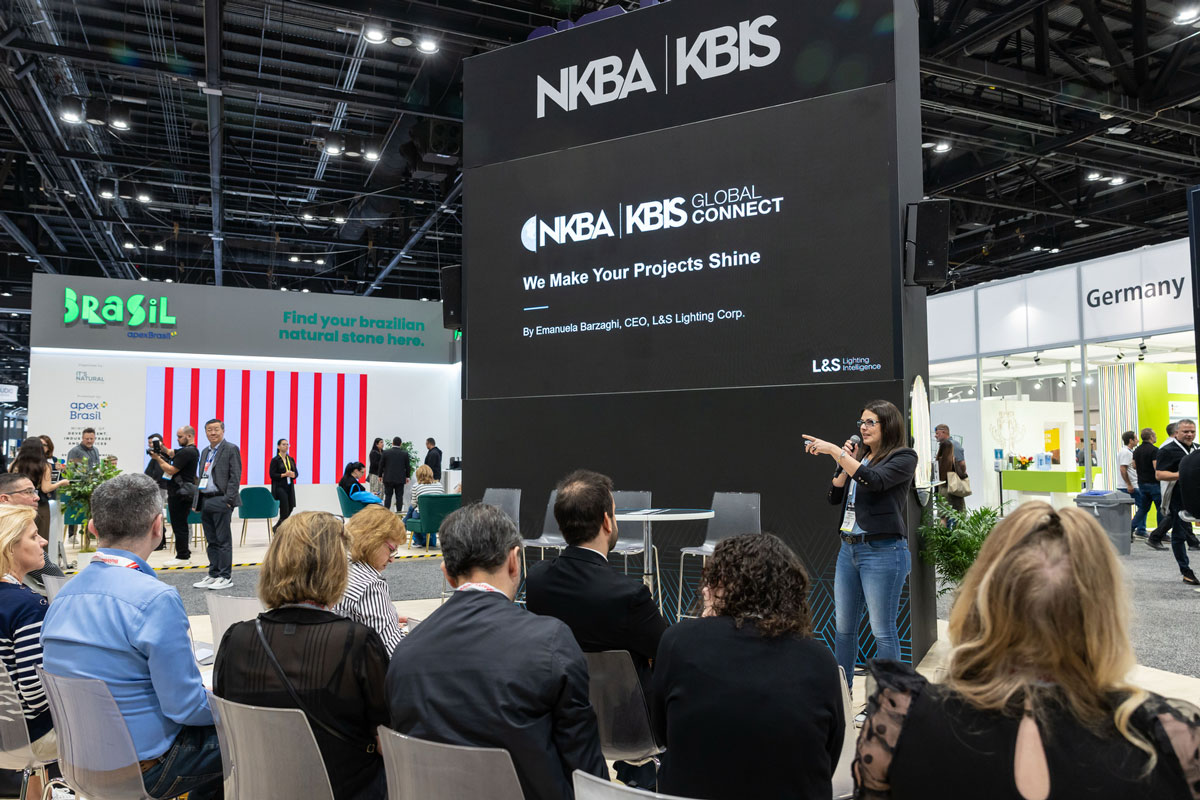
Laurent, an NKBA Global Connect Advisor, presented a session at KBIS 2026 in Orlando last month that illustrated how far design ideas travel before they reach the American luxury market. The presentation, part of Global Connect programming at the show, examined key European design movements shaping K&B this year, how European values translate to North American lifestyles and scale, and how American brands, designers and manufacturers can adapt successfully.
“European design directions are responding to structural realities,” she began. “They are focused on environmental realism, as opposed to sustainability just on the surface. Most European homes have a smaller footprint, so they require higher performance per square foot. In Europe, they pay greater attention to craftsmanship and heritage.”
Laurent pointed to seven indicators where the European mindset can influence North American design trends.
• Quiet luxury as a market differentiator. “Europeans are not flashy,” she said. “They are quiet and elegant.” This signals matte finishes, tonal depth, low reflectivity, detail over drama, softer stones and reduced contrast. The American takeaways are that luxury is shifting from big visual impact to material intelligence, and that craftsmanship and consistent finishes drive perceived value. “Brands and products that communicate quality will quietly outperform those reliant on bold aesthetics,” she added.
• Soft modernism. The European direction calls for softer architecture and rounded forms, with comfort-first silhouettes replacing stark, rigid minimalism. In kitchen and bath, this means curved vanities and millwork, rounded mirrors and sculptural finishes, and softer transitions throughout interiors. For brands, this means that curves and softer profiles stand out in a market full of hard, modern lines.
• Material honesty and long-term product value. In Europe, there’s a truth to materials over applied decoration. Textures — plaster, limewash, limestone, slatted wood and ribbed glass, and tactile cabinetry surfaces — replace pattern for visual interest. “Texture-forward products reduce reliance on trend cycles and extend product relevance,” she noted.
• Warm minimalism and scalable color systems. Neutrals are becoming layered and dimensional, with warm grays, sand, oat, camel and ecru displacing white-on-white palettes for more tonal continuity. In the U.S., this signals a natural evolution beyond the all-white kitchen era, and brands that offer tonal systems will see longer product life cycles.
• Personalization through integrated systems. The European approach is for more built-in, architectural planning from the start, with fewer add-ons and more integrated solutions. This includes integrated pantry and beverage zones, hidden doors and pocket systems. For brands, the message is that integrated systems increase spec value and deepen designer loyalty when supported with clear planning tools.
• The evolution of stone. In Europe, we see softer, warmer stone palettes, honed finishes with subtle movement, and refined textures over bold contrasts. In the U.S., this creates the calm, immersive environments that many homeowners crave, with warm tones and broad luxury appeal. Refined, low-contrast stone expands market appeal while maintaining a premium perception.
• Wellness-led baths as a growth category. “There’s a lot of noise pollution everywhere,” Laurent said. “A lot of European R&D goes into softer lighting and sound solutions.” Europeans approach the spa as architecture, not merely decoration, with calm palettes, integrated storage, and ambient lighting. Key drivers include steam, infrared and hydrotherapy awareness, acoustic softness and visual restraint. Brands should note that wellness-driven products justify premium positioning when performance and consumer education are clearly communicated.
Translating European Products to the American Market
“North America expects performance and convenience, with clear specs, certifications and logical installation instructions, as well as reliable lead times and service support,” she said. Gaps in size, lifestyle differences, speed expectations, and consumer education can be rectified by translating systems into familiar terms, taking advantage of local inventory and distribution, and providing the tools, training, and storytelling the market needs. “The core message is that European brands don’t need to change who they are, they need to communicate it in American language.”
Why is Florida a Reliable Test Market?
Florida comprises design-literate, well-traveled luxury buyers. It’s a fast-paced market for residential construction, and there’s a preference for lightness and refinement in design. Tonal palettes that stay bright, natural materials that feel elevated, kitchens that feel residential (not like a showroom), and spa-inspired bathrooms with restraint work well in this market. “The U.S. is very regional and segmented,” she added. “Florida is often a predictor of broader American luxury adoption patterns.”
Key Takeaways
Kitchens and baths are becoming more architectural and tailored, materials are becoming more tactile and emotionally resonant, and luxury is shifting toward intelligence, not excess. Laurant advised brands to invest in translation, not just market expansion, to understand how a singular message can apply to local markets. Designers, she said, should sell craft and longevity, not surface finish. “Storytelling is really important,” she added. And manufacturers should support adoption through education availability and performance.
“The future of luxury is not louder,” she concluded, “it’s smarter, and it feels personal.”
NKBA’s Global Connect international business membership program helps foreign brands explore entry or increased market presence in North America with valuable benefits, including access to exclusive research and advice from Strategic Advisors like Laetiia Laurent on a range of topics, like market analysis, brand positioning, compliance, and distribution. The Global Connect international media program also brings business journalists from the UK, Germany, Spain, Italy, and Brazil to KBIS to learn about the innovations, technologies, and new products emerging in North America.