








K&B Subject Matter Expert Corey Klassen, RID, NCIDQ, CMKBD, reveals the evolution behind an industry standard.

By NKBA Staff
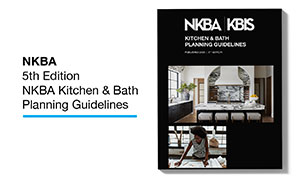
The NKBA’s Kitchen & Bath Planning Guidelines have been the industry’s gold standard for years, serving as an essential reference for design professionals. Published since 1992, it is the most complete collection of illustrations and planning recommendations available in one source, covering the planning and installation of beautiful, efficient, code-compliant kitchens and baths and other interior spaces.
As the industry evolves, the Planning Guidelines must be adapted to changing codes and regulations, technology and material advancements, and design and building trends. This is a painstaking, highly detailed process.
Enter Subject Matter Expert Corey Klassen, RID, NCIDQ, CMKBD, an award-winning interior designer and owner of Articulated Design Studio (founded as Corey Klassen Interior Design in 2011) in Vancouver, British Columbia. Klassen has been a leading expert of the Planning Guidelines revisions for the last two editions, including the most recent fifth edition, with the collaboration of other SMEs and key stakeholders, including educators, practitioners, and accessibility advocates.
The transition from the third edition to the fourth was “a monumental lift,” and the new fifth edition has even more refinement, said Klassen, who traveled from Vancouver to the U.S. to take the NKBA certification exams – AKBD, CKD, and CBD. “Our overall objective was to increase comprehension through clarity and consolidation, and that meant paying very close attention to our word choices and layout so that the Planning Guidelines can be more universally understood.”
Klassen revealed that some key updates and revisions to the fifth edition included further defining the best practices for accessibility in “Chapter 1: Human Factors and Accessibility,” expanding storage systems and finishes in “Chapter 6: Interior Environment Planning,” and extensive clarity on ventilation, power, lighting, and illumination planning in “Chapter 7: Building Systems Planning.”
“A new comprehension tool we introduced was the use of notes after each guideline, where we were able to capture additional context, related factors and considerations, and additional short-form context.”
Klassen said their top challenge was to bring parity across international borders. “I often remark to my U.S. colleagues that while we may speak and read similar English, that closeness can still have great diversity and nuance in building codes. I think we all understand that model codes, such as the International Residential Code, change every four years, but a key driver was a lesser-known compliance publication in Canada called CSA/ASC B652 Accessible Dwellings (2023). What was remarkable to all the subject matter experts, including myself, was how much further along this technical publication was in accessibility, and we embraced it through many lively discussions, researching and sourcing supporting reference materials, and with conversations in each of our communities.”
Inclusivity is central to Klassen’s overall design approach and played a significant role in revising the fifth edition of the guidelines.
“Terms such as ‘design from the margins’ and ‘nothing for them without them’ are fundamentals that help define how empathy is applied in my daily routine,” Klassen said, adding that it was important for individuals to be able to synthesize the Planning Guidelines. “Some of the deeper challenges that we are all facing are constant cognitive overload, common language evolution, and the rate and speed at which artificial intelligence and technology are influencing us. For me, this meant that regardless of which nationality, race, physical ability, disability, or language that characterizes the reader, that the Planning Guidelines can be understood. Facts provide clarity. I think this is what my husband and I endeavor to embody in our interior design firm.”
Klassen concluded, “I have been afforded so many professional opportunities to expand my skills, knowledge, and professionalism through my membership with the NKBA. It has been a tremendous honour — I’m Canadian, it’s how we spell it — to work on, collaborate with, research, synthesize, write (and rewrite) the Planning Guidelines into this new experience for Certified Kitchen & Bath Designers, Certified Master Kitchen & Bath Designers, and allied design professionals across many industry sectors.
“We owe a tremendous thank you to Doug Walter, CMKBD; Robin Rigby-Fisher, CMKBD; Judith A. Neary, CMKBD; and Cailin Thelen, CMKBD, as the subject matter experts for their contributions to the 5th edition, as well as Adrean Stephenson, CKBD of Chief Architect, Inc., who served as the primary illustrator of figures in the publication. For those considering NBKA Certifications, it will be a journey that might need reframing at times, but it’s important that we look at our learning CEU’s not just as requirements, but opportunities to study areas we wouldn’t typically practice.”
Learn more about the NKBA Kitchen & Bath Planning Guidelines here.