






Breaking Down the Key Question for Global Kitchen & Bath Brands
By John Watson, Executive Vice President, Industry Relations & Business Development, IAPMO

I regularly speak with kitchen and bath manufacturers from Europe or Asia who have seemingly done everything right in their home market.
Solid product. Rigorous testing. Genuine commitment to quality.
They arrive in the US and start meeting with distributors, wholesalers, and large retailers. Then someone asks: “Is it listed?”
That question stops a lot of conversations cold.
The U.S. market is not necessarily harder than other markets, but it’s structured in a way that requires a specific kind of preparation–including proper product certification. Understanding that structure early in your product development process affects your speed to market.
Why Your Existing Certifications Don’t Transfer
The most common question I hear from European manufacturers is some version of: “We already have CE certification. Why doesn’t that count here?”
The U.S. system is built on independent, third-party verification, not self-declaration. CE marking, even when backed by rigorous internal testing, is not accepted by U.S. authorities having jurisdiction (AHJs). These local inspectors–the people who actually approve products during construction–need to see marks from accredited third-party certification bodies. That’s the standard expectation in North America.
It’s important to understand there is no single national authority that approves your product for the entire U.S.
Instead, state and local jurisdictions adopt model codes–sometimes with amendments–and enforce them independently. This creates a real complexity that catches many international kitchen and bath brands off guard. A good certification partner helps you anticipate and navigate those variations before they become delays.
What “Certification” Actually Means in This Market
For brands aiming to scale in the U.S., certification is a strategic foundation, not just a regulatory step. Independent certification programs help verify your authenticity through public directories that support enforcement efforts to remove non-compliant and potentially unsafe products from the market.
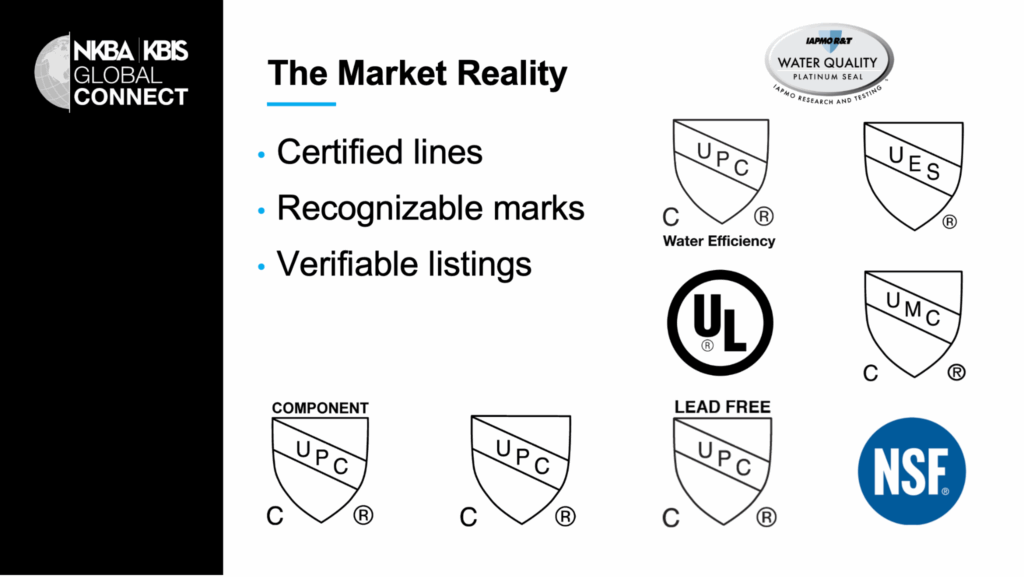
The marks that carry the most weight in the kitchen and bath category include UPC® and cUPC® for plumbing products, NRTL listings such as IAPMO, UL or ETL for electrical components, IAPMO, NSF, or WQA marks to NSF/ANSI standards for products in contact with drinking water, and the EPA WaterSense logo for water-efficient fixtures.
When an AHJ looks at a product during a building inspection, they are looking for these marks. That mark is shorthand for a documented chain of evidence: an accredited third party tested this product to a specific standard, reviewed the manufacturing documentation, inspected the facility, and listed the product as safe and compliant.
In jurisdictions where code compliance is required, products without a recognized listing simply cannot be installed. Many U.S. distributors, wholesalers, and large retailers prefer or require certified product lines to reduce liability and callbacks, while architects and engineers often require certification marks as part of their submittal review process.
Certification Process Issues That Create the Longest Delays
In my experience, three situations create the most timeline angst for manufacturers entering the U.S. market.
- Starting certification too late. A straightforward product with an existing applicable standard and no material concerns can move through testing and certification in roughly 10 to 12 weeks. New technology, non-standard materials, or even a missing drawing or a gap in documentation, adds time. Manufacturers who begin the certification process after signing a distribution agreement are already behind.
- Not knowing which standards apply. This sounds basic, but I think I’ve made the point that the U.S. standards landscape is genuinely complex. ASME, ASSE, CSA, NSF, IAPMO, and others each publish standards covering different product categories. Identifying the right standards for your product, including any state-specific requirements such as California’s Title 20 flow rate rules or its lead content regulations, requires expertise in both product categories and regional code adoption.
- Offering a product that doesn’t fit any existing standard. This is usually a great thing: you’ve pioneered a new technology! Smart fixtures, integrated filtration systems, and novel materials may not map cleanly to any current standard. This is a solvable problem, but it adds considerable time. The best approach is to surface this issue as early in the development process as possible.
The U.S. market rewards preparation. Manufacturers who understand the landscape before they commit to tooling, distribution agreements, or launch timelines tend to move through the process faster and with fewer surprises.
John Watson is EVP, Industry Relations & Business Development of IAPMO, celebrating its 100th anniversary in 2026. John serves as an NKBA Global Connect Advisor helping international manufacturers navigate U.S. market entry.
About NKBA Global Connect
The NKBA Global Connect mission is to connect and grow the kitchen and bath industry around the world through an international membership program. The initiative equips international companies with the support and professional community access they need to thrive in North America by providing market intelligence, brand-positioning guidance, and connections to key North American audiences. By combining NKBA’s expert marketing execution with access to a diverse and influential member network, we help businesses improve visibility, build meaningful relationships, and generate strong market demand, ultimately accelerating their success in the lucrative and competitive $228 billion North American market. Learn more here.